



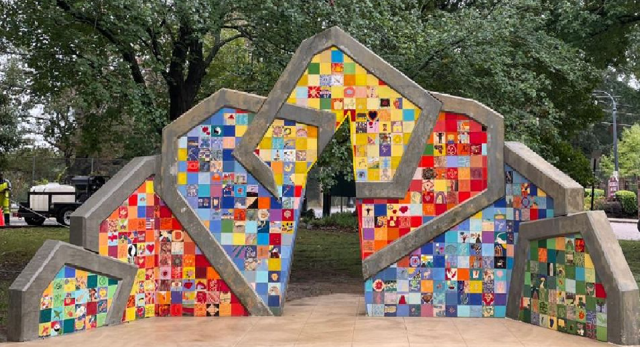
ATLANTA— The Rebirth” sculpture in Atlanta’s Summerhill community has been restored, thanks to the City of Atlanta’s Cultural Affairs Conservation and Maintenance Team. Mayor Andre’ Dickens’ Office of Cultural Affairs announced the completion of the restoration effort in its Nov. 6, 2026 online newsletter.
Summerhill is one of Atlanta’s oldest communities and is sandwiched near downtown Atlanta between the Grant Park neighborhood to the East and the Mechanicsville neighborhood to the West.
The colorful Rebirth sculpture was created in 1996 by Patricia Cunfer and members of the Summerhill community. It consists of many hand-painted tiles done by children. Now, it stands as a time capsule to all those who were children 30 years ago.
Located at the intersection of Connally Street (around 612 Connally St. SE) and Georgia Avenue SE, the freestanding sculpture at Phoenix III Park is double sided with hand-painted tiles and has an opening in the center of the structure with outwardly extending arms on both sides. It’s a great place for residents, visitors, history buffs and photographers to snap a selfie or photo as they explore Atlanta.
One of two settlements established after the Civil War by William Jennings in 1865, Summerhill’s early inhabitants were freed slaves and Jewish immigrants. Wood’s Chapel and Clarke’s Chapel began offering worship services in 1866 within close proximity of each other. Wood’s Chapel subsequently became Allen Temple AME. Church. Clarke’s Chapel’s congregation was mixed and sought to also promote education which it accomplished by holding the first classes of Clark College and Gammon Theological Seminary in its basement. Clarke’s Chapel was ultimately renamed the Lloyd Street Church. In 1867 Frederick Ayer founded his school at Richardson and Martin Streets. The Atlanta Board of Education bought it three years later, making it the only public school for Black children in the City. The school was eventually renamed the E. P. Johnson Elementary School.
History of Summerhill
Summerhill was once considered the most prosperous African-American community in Atlanta and was a relatively stable residential community for almost a complete decade. It was home to several of Atlanta’s influential civic and business leaders: Sam Massell, Herman Russell, S. W. Walker, and Leon Eplan are a few whose life began in Summerhill. But, like neighboring Mechanicsville and Peoplestown, Summerhill fell victim to economic and political pressures beyond its control. As Atlanta grew to the North and West during the early part of the twentieth century, the more affluent moved to larger lots with bigger houses. The politics of Urban Renewal left Summerhill with a prevalence of dilapidated, sub-standard housing, vacant lots, and abandoned commercial buildings. By the 1960s, Summerhill was inhabited the victim of absentee landlords’ lack of maintenance.
In the mid-1960s, a riot occurred in Summerhill over the shooting of a black male by the police. This incident gave Summerhill national attention but, more importantly, served to galvanize residents into civic action, which resulted in the formation of a neighborhood organization, Summerhill Neighborhood Inc.
By 1990, through the efforts of the neighborhood organization a CDC, Summerhill Neighborhood Development, Inc., was founded to take charge of the physical redevelopment of the neighborhood which the awarding of the 1996 Olympics to Atlanta gave Summerhill its first opportunity for revitalization. In 2004, a new neighborhood organization was formed, the Organized Neighbors of Summerhill, and in conjunction with SNDC worked to ensure that Summerhill regained its former stature in the community.
Source: www.onsummerhill.org